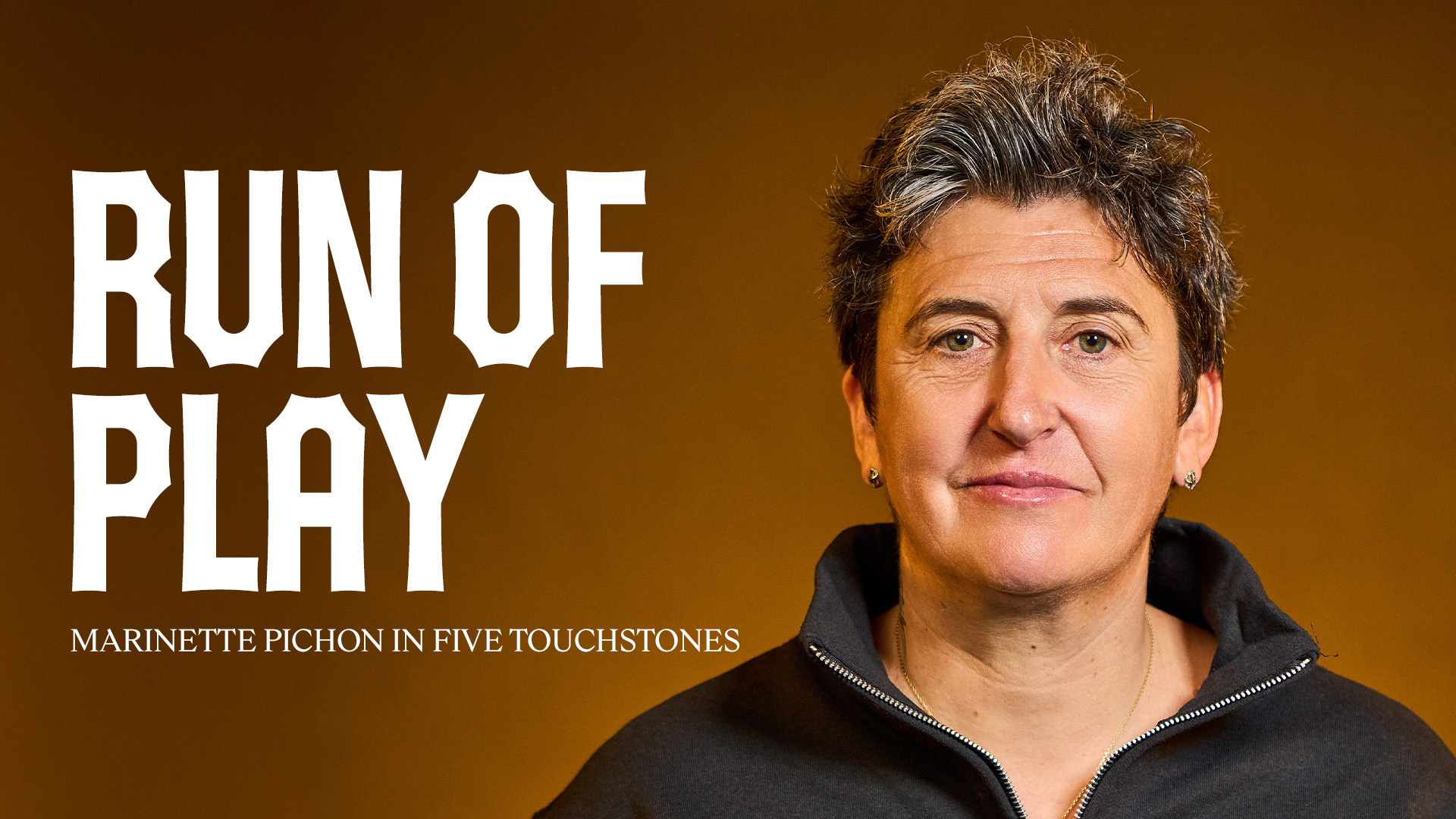
Marinette Pichon in five touchstones
By Lisa Cecchini, Editor, lstw
Some spaces shape a career. Others shape who we become.
Some are easy to name: the locker room, the pitch, the sidelines. Others, like the feeling of truly belonging, are felt rather than found.
Marinette Pichon's path runs through them all. Together, they trace more than three decades of soccer while revealing the woman behind one of the sport's defining careers and a much more personal story about coming into her own, finding home and making space for others to find theirs.
This isn't about titles, records or trophies. It's about everything in between.
The locker room
The locker room is where teams are built. For some, it's also where belonging takes root.
Ask Marinette Pichon where she first felt she truly belonged, and she'll take you by the hand to Philadelphia. Not to the pitch but to the locker room.
It was there, with the Charge, in the Women's United Soccer Association, that she found a place where being herself was enough.
"Without a doubt, it was the locker room in Philly. The players were completely committed, but they were also incredibly accessible. I felt supported. There was no judgment. They loved you and accepted you as you were, with your strengths and your flaws. On the pitch, it all became so much simpler.”
Her move to the United States meant more than joining a new club. For the first time, her game reflected who she was.
“That's where I truly became myself. As a person, as a woman, but also as a player. I could express a kind of leadership I'd shown elsewhere but never fully. In Philadelphia, everything finally felt whole. I showed up exactly as I was. I wasn't holding anything back."
Soccer was only part of the story.
Over time, sport stops being the only thing that holds a team together. Wins and losses still matter, but they give way to something deeper.
"You go through adversity together. You go through success together. You open up. The people who were only teammates become people you build real connections with. Then, one day, you realize you don't just want to play alongside them anymore. You want them in your life because there's mutual recognition."
The jersey
You put on a jersey to play, but before long it starts to mean more than its colours. It becomes legacy, identity and commitment. It links every player who wore it before with those still to come.
For Marinette, it marked an arrival: a place in the starting eleven, a call-up to the national squad.
"The first jersey that really mattered was the one I wore for the French national team. My first match with France was on March 26, 1994. Hearing La Marseillaise for the first time, that's when it all became real. You go through every emotion. You're happy. You're scared. Your legs are shaking. You wonder if you'll forget the words. Then, all at once, you realize you're representing your country."
Eventually, the crest became bigger than any one player. It didn't end with her.
"I remember players who identified with me, including the striker who broke my scoring record. It still feels strange when people ask for an autograph because, to them, I was a role model. I'm proud, but it still feels surreal. It's always strange to know that someone admires you."
But admiration was never the point.
"What matters even more is when people recognize me for the person I am, not just the player I was. I had those sporting qualities because I was that person. It's a virtuous circle."
The pitch
The pitch reveals as much about the person as it does the player.
"I felt the freest in the United States. I arrived from France in a position of strength. I was the top scorer for the French national team and in the French league. Then I stepped outside my comfort zone. I questioned everything. I felt vulnerable. It took me nearly three months to adapt."
The turning point came one morning, and it had nothing to do with the club.
"I woke up and told myself, 'Okay. It's time to enjoy this. Be yourself. Joke around. Speak up.' From that moment on, I wasn't afraid anymore. I was finally myself. I stepped onto the pitch and started trying things I'd never attempted before."
It all fell into place, including her game.
"When I held back who I was, I was also holding back my abilities as a player. The moment I stopped doing that, I finished as the league's top scorer. I was named MVP in my first season. I scored 14 goals. The following season, I scored 14 again. I made the all-star team. I became indispensable."
Looking back, Marinette doesn't describe it as a breakthrough in form but as a kind of liberation. The confidence she'd arrived with had never disappeared. It had simply been buried beneath doubt. Once she stopped waiting for permission to be herself, everything else followed.
"I shifted to an American mindset, where anything was possible. I realized no one was going to change my destiny for me. No one was going to run in my place. No one was going to take the shot or make decisions for me. I had to become that person. I had to take responsibility. And I did."
When she returned to France, women's soccer had evolved. The sport had grown and so had the attention surrounding her. But that was never what she set out to find on the other side of the Atlantic.
"I didn't move to the United States for soccer. I did it for myself. It wasn't about giving back to the game or paying back what the sport had given me. It was about becoming myself, and that's difficult. Sport gave me the chance to do that, and it helped me grow as a person."
The sidelines
From the sidelines, the game reads differently.
The challenges are different now. It's not about how to score the next goal anymore. It's about helping someone else reach theirs.
“Today, the game belongs to the players on the pitch. My job is to see everything around them: the demands of each position, injuries, contract negotiations, self-doubt, fatigue. My job is to understand their reality so I can help them navigate it. You can't ask a player to do something if you don't understand what they're going through."
Her role changed, and so did what she needed to see.
"I'm constantly questioning myself. Every day brings a new situation. What's the best way to approach it? What impact will my decisions have on the player, the team and the staff? The sidelines force you to see things from a different perspective every single day."
Marinette will tell you that real progress begins with curiosity, questions and an environment you create for players to grow. It’s a philosophy of patience. Development before results. Curiosity before confidence.
"Players improve because they're curious. They ask questions. They want to understand and get better. The project comes before the result. If you know how to help your players improve, the results will come."
Soccer still moves her, just differently.
"I love watching my team play. I love seeing the work the staff has put in throughout the week come to life on the weekend. I love seeing the players celebrate together. Knowing that I can bring a little of what I've lived through to help put them in the best possible position, that's incredibly rewarding."
Home
Home isn't always a place. Sometimes, it's the people who make you feel you don’t have to earn where you belong.
It took Marinette years to realize the hardest journey wasn’t finding home. It was unlearning everything that had taught her to doubt it.
"Like so many women, I've struggled with impostor syndrome. Not because I thought I didn't belong, but because other people made me feel that way. Parents. Coaches. The way women's sport was treated. You can quickly start believing women don't really have a place in sport. The best pitches are for the men. You always get the last training slot.”
Those messages don’t just disappear. Hear them often enough, and they become the prism through which you see yourself. The real work wasn't becoming someone else. It was letting go of everyone else's expectations.
"Today, I don't care about other people's opinions. At some point, you decide if you want to worry about what everyone else thinks or if you just want to feel good? I chose the second option. But it's work. Real work. Some days are easier than others."
She didn't get there alone. One person more than anyone else believed in her before she could fully believe in herself: her wife.
"She was the first one who made me feel I was in the right place. She always told me to believe in myself, face my fears. We'd already accomplished so much when we met, but there was still another step I needed to take, and she helped me take it. She saw things in me that I couldn't see in myself yet."
Today, that feeling belongs to neither one person nor one place.
So, where does Marinette feel most at home?
"Everywhere.”
First as a woman. Then as a mother and grandmother. “My family is exactly where I belong. They take me as I am. At work, too, I'm exactly where I belong. There's always room to improve, but I know I'm in my place."
Finding her place didn't change her path. It simply proved she had been right to trust it.
"It validates everything I've done. My convictions, the positions I've taken. I still have to keep questioning myself because being in my place doesn't mean I do it all right, but it validates the courage I've had."
History remembers what can be counted.
The numbers, the achievements, the honours.
They're all part of Marinette Pichon's story. They just aren't the whole story.
Long before she left her mark on soccer, she was pursuing something else entirely: a life where she would never have to be anyone but herself.
The hardest part wasn't stepping into who she was. It was having the courage to remain true to herself, even when the world suggested otherwise.
Maybe that's where her legacy speaks most clearly: not only in what she accomplished, but in what she made possible. First for herself, then for everyone still learning that being yourself is enough.