A Black History Month Feature | Montréal Roses
OLIVIA | A BLACK HISTORY MONTH FEATURE
Published on
February 27, 2026
Share this Post
When Olivia MBala left Canada in 2015, there was no professional women’s soccer league to stay for. If you wanted to play at the highest level, you had to leave. So she did.
She went to France. Grenoble first, then Rodez, then Saint-Malo, then Lille. She adapted to the culture.
In July 2025, she came home.
The Northern Super League had launched that spring. Canada finally had what it had been missing. And Olivia MBala, at 33, signed with the Montréal Roses to do something she’d never been able to do before: play professional soccer in her own country.
“Where you come from is a strength.”
The World in One Place
She grew up in Scarborough, in Toronto's east end. If you know the neighbourhood, you know what it means: dozens of languages on the same block, West Indian bakeries next to Vietnamese restaurants next to Somali grocers next to Portuguese cafés, one of the most diverse communities in Canada.
"I always felt lucky to grow up there," MBala says. "Being surrounded by people from so many different backgrounds shaped my perspective from a young age. Different cultures, languages, foods, traditions, every day. That diversity gave me a strong sense of pride in where I'm from."
It felt, she says, like the world in one place.
Her father, Lopez, is from the Democratic Republic of the Congo. Her mother, Yolande, raised Olivia and her brother Andrew in a household where Congolese culture was always present: the food, the music, the values, the constant reminder of where the family came from and what that heritage meant.
"My heritage has always been a meaningful part of who I am. There was always pride in where we come from, and my family made sure we understood that."
Football was the family's shared language. The MBalas are Arsenal supporters, and not the casual kind. They're the kind who plan their weekends around matches, who celebrate wins like holidays, who spend dinner debating tactics and reliving goals. For Olivia, the sport was woven into family life from the beginning, something that connected them all.
"It was more than a sport. It was something that brought us together. A family tradition. A shared language."
Before She Left
MBala started playing at five with Wexford SC, and by high school at Birchmount Park Collegiate she was a four-sport athlete: soccer, volleyball, cross country, basketball. By 17, she was training with Canada's national youth program, and at 18 she left for the University of North Carolina to play under Anson Dorrance, the coach who built the Tar Heels into a dynasty with 21 national championships and a program that had produced Mia Hamm. Her teammates included Crystal Dunn, future star of the U.S. Women's National Team.
She scored her first collegiate goal in October 2010, a header off a corner kick in a 5-1 win over Clemson. After one season, she transferred to Florida Atlantic, where she became one of the best defenders in Conference USA. She earned All-Conference First Team honours in 2013, and in 2014 she was named Conference USA Preseason Defensive Player of the Year.
Then came graduation, and with it the question every Canadian woman who wanted to play professional soccer had to answer: where now?
There was no league at home. So she bet on herself and bought a ticket to France.
A Decade in France
Grenoble, 2015. Division 2 Féminine, the second tier of French women's football.
MBala didn't speak the language when she arrived. She learned it. She adapted to the rhythms of a new country, a new football culture, a new life. And she earned her place.
What followed was a 10-year career that took her across French football. Four years in Grenoble, where she established herself as a reliable centre-back. Then Rodez. Then Saint-Malo. Then Lille OSC, one of the most historic clubs in French football, where she signed in 2022.
A knee injury delayed her Lille debut for months, but she came back and became a key part of the team's defensive core. She helped Lille earn promotion to D1 Arkema, the French top flight, and when the club faced relegation the following season, she stayed and kept fighting. A decade of proving herself at every level, at every club, in a country 5,000 kilometres from home.
It was the kind of career that required patience and persistence, the willingness to keep working. MBala built something real in France, a body of work that speaks for itself.
Home
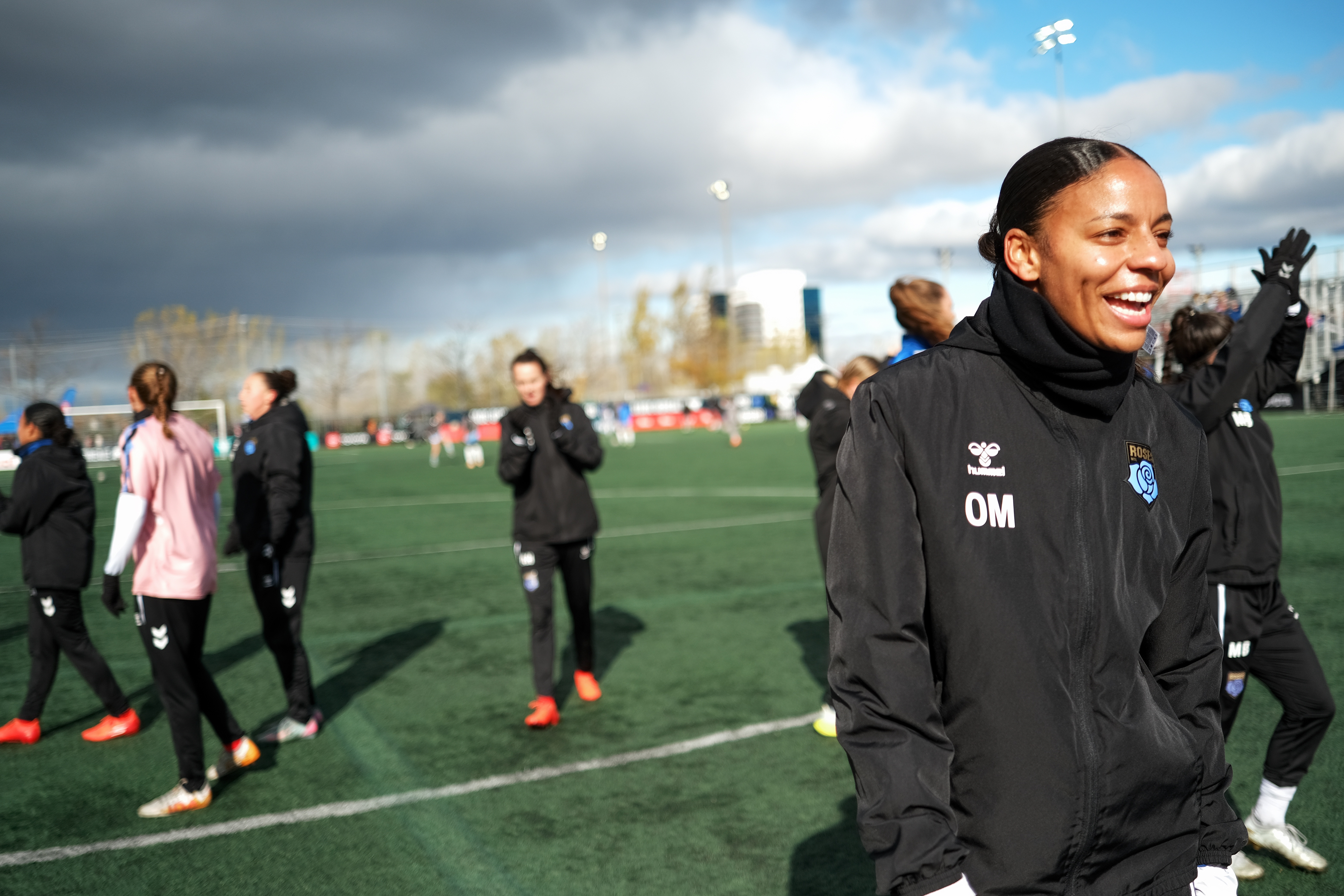
The Roses had reached out at the start of the 2025 season. MBala was interested, but she still had months left on her contract with Lille, and she wanted to see it through. When she finally signed in July, head coach Robert Rositoiu made clear what she brought to the club.
"Olivia fully embodies the Roses' values: discipline, commitment, and authenticity. She's not just a top-level performer. She elevates those around her."
She made her debut on August 3, coming off the bench against Halifax. Ten years after leaving, she was playing professional football in Canada.
What She Carries
MBala thinks often about what it means to represent her family when she steps on the pitch. The Congolese heritage from her father. The values her parents instilled. The sacrifices that made her opportunities possible.
"I think my heritage influenced me more than I realized at first. There's a passion, a rhythm, a creativity that's part of Congolese culture, and I try to bring that energy onto the field. I'm carrying more than just my own name. I'm representing my family's journey."
She also thinks about the girls coming up now, the ones who will have something she didn't: a professional league in their own country, a path that doesn't require leaving home. In high school, MBala organized a Black History Month presentation for her classmates at Birchmount Park Collegiate. Even then, representation mattered to her. It still does.
"I want young Black girls in Canada to see my story and understand that where you come from is a strength. Growing up in a diverse, hardworking community taught me resilience, pride, the importance of staying connected to who you are. I hope they see that their dreams are valid, no matter how big."
"You belong in every space you aspire to be in. Sports, business, the arts, whatever it is. Sometimes just seeing someone who looks like you can make all the difference."
Her Instagram bio carries a quote from Eleanor Roosevelt: "No one can make you feel inferior without your consent." It speaks to how she's moved through the world, and what she hopes to pass on.
"Be proud of your background. Lean on your support system. And never be afraid to take up space."
Full Circle
At 33, Olivia MBala is one of the most experienced players on the Roses roster. A decade in France. Over 100 professional matches. The steadiness that comes from building a career through persistence rather than shortcuts.
She left Scarborough at 18 for North Carolina. She left North America at 23 for France. She came back at 33 because there was finally something to come back to.
The world in one place, she called her hometown. She went out and played in it. Now she's home, carrying all of it with her.
—
About This Series
This feature is part of the Montréal Roses’ Black History Month series, celebrating the Black players who make our club what it is. Throughout February, we will publish in-depth profiles of our athletes to honour the full breadth of who they are : their journeys, their values, their personalities, and their perspectives. These are stories of excellence, resilience, and community. We are proud to share them.